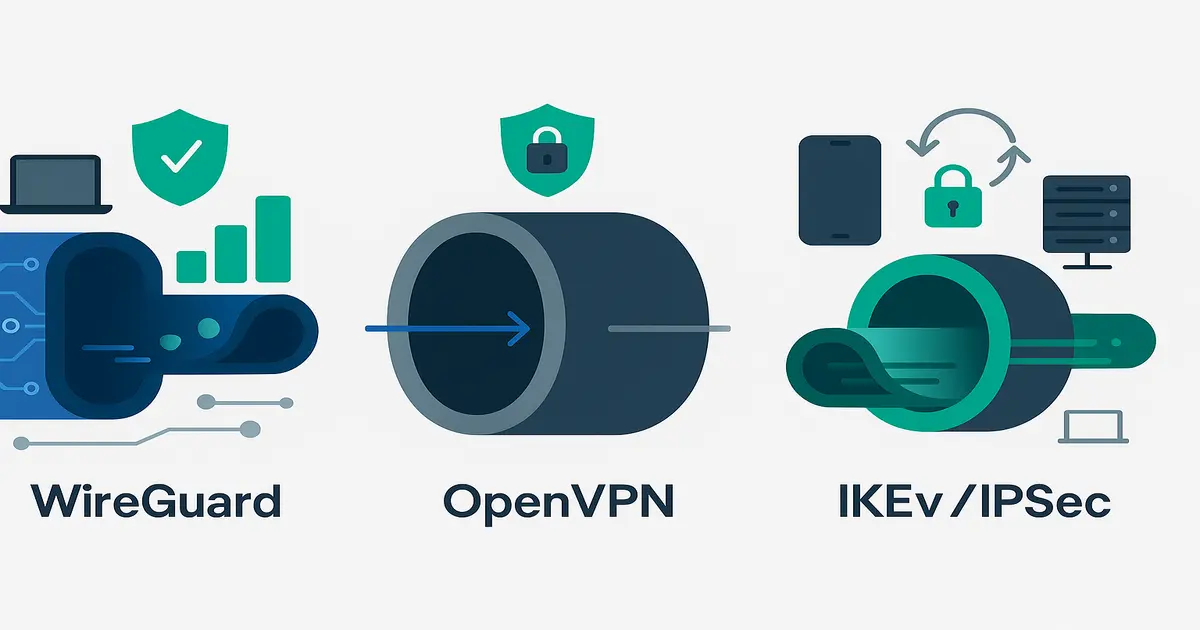

Three VPN protocols matter most in 2025: WireGuard, OpenVPN and IKEv2. Knowing how they differ helps you make informed decisions about your online security.
What Are VPN Protocols?
VPN protocols are sets of rules and procedures that determine how data is transmitted between your device and the VPN server. Different protocols offer varying levels of security, speed and compatibility.
WireGuard: The New Standard
Overview
WireGuard is the newest VPN protocol, officially released in 2020. It was built to be faster and more secure than older protocols, with a simpler design.
Features
- Modern cryptography: Built on current encryption algorithms
- Minimal codebase: Only 4,000 lines of code (vs 70,000+ for OpenVPN)
- Excellent performance: Significantly faster than older protocols
- Battery efficient: Great for mobile devices
- Easy to audit: Simple code makes security audits easier
Pros
- Fastest speeds among all protocols
- Strong security with modern encryption
- Low battery consumption
- Quick connection times
- Cross-platform compatibility
Cons
- Relatively new (less battle-tested)
- Limited configuration options
- Some privacy concerns with IP logging
OpenVPN: The Reliable Veteran
Overview
OpenVPN has been the gold standard for VPN protocols since 2001. It's open-source and highly configurable. It has also been extensively tested.
Features
- Open source: Transparent and community-audited
- Highly configurable: Extensive customization options
- Strong encryption: Uses AES-256 encryption
- Port flexibility: Can run on any port
- Firewall bypass: Excellent at bypassing restrictions
Pros
- Proven security track record
- Highly configurable
- Excellent for bypassing censorship
- Strong community support
- Works on virtually all platforms
Cons
- Slower than newer protocols
- Higher battery consumption
- More complex setup
- Larger codebase (harder to audit)
IKEv2/IPSec: The Mobile Champion
Overview
IKEv2 (Internet Key Exchange version 2) paired with IPSec is particularly popular for mobile VPN applications due to its stability and reconnection capabilities.
Features
- Excellent stability: Handles network changes well
- Fast reconnection: Quickly reconnects after interruptions
- Strong security: Uses well-established encryption standards
- Native support: Built into many operating systems
- NAT traversal: Works well behind firewalls
Pros
- Excellent for mobile devices
- Fast connection and reconnection
- Strong security
- Good speeds
- Native OS support
Cons
- Limited server support
- Can be blocked by firewalls
- Less configurable than OpenVPN
- Potential NSA vulnerabilities (disputed)
Protocol Comparison Table
| Feature | WireGuard | OpenVPN | IKEv2/IPSec |
|---|---|---|---|
| Speed | Excellent | Good | Very Good |
| Security | Excellent | Excellent | Very Good |
| Stability | Good | Excellent | Excellent |
| Mobile Battery | Excellent | Poor | Good |
| Firewall Bypass | Good | Excellent | Fair |
| Setup Complexity | Easy | Complex | Medium |
| Maturity | New | Mature | Mature |
Which Protocol Should You Choose?
Choose WireGuard if:
- You care most about speed and performance
- You use mobile devices frequently
- You want the latest security technology
- You prefer simple, modern solutions
Choose OpenVPN if:
- You need maximum configurability
- You're in a restrictive network environment
- You want proven, battle-tested security
- You need to bypass strict censorship
Choose IKEv2/IPSec if:
- You primarily use mobile devices
- You frequently switch between networks
- You want native OS integration
- You need reliable reconnection capabilities
Conclusion
Each VPN protocol has its own strengths and ideal uses. With its speed and modern security, WireGuard looks like the future. OpenVPN is still the most versatile and proven option. IKEv2/IPSec does best on mobile.
Most modern VPN services offer multiple protocols, so you can choose based on your needs. The best approach is often to test different protocols and see which works best for you.